









NEW DELHI: What began as a routine interaction in Delhi has culminated in the most serious internal crisis in the history of the Trinamool Congress, resulting in a split that has shaken the party founded by Mamata Banerjee nearly three decades ago.On Wednesday, a group of 58 rebel MLAs led by expelled leader Ritabrata Banerjee claimed control of the TMC legislature party after securing recognition from Assembly Speaker Rathindra Bose. The dramatic development capped nearly two weeks of escalating tensions fuelled by allegations of forged signatures, resentment over the growing influence of Abhishek Banerjee and an increasingly visible succession battle within the party.The seeds of the crisis were sown in the aftermath of the party’s assembly election defeat on May 4. Discontent began surfacing among sections of newly elected legislators, many of whom privately expressed concern over what they saw as the concentration of power around Abhishek Banerjee, the party’s national general secretary and Mamata Banerjee’s nephew.Those concerns became more pronounced during a meeting of MLAs on May 6 when Mamata Banerjee reportedly asked legislators to applaud Abhishek for his role in the election campaign. While intended as a gesture of appreciation, some members interpreted it as a sign of the growing prominence of one family within the party structure.The early signs of dissentThe first public signs of dissent emerged on May 19. During a meeting of legislators, Ritabrata Banerjee and Entally MLA Sandipan Saha questioned why Falta MLA Jahangir Khan had not faced disciplinary action despite publicly withdrawing from the repoll campaign. Given Khan’s perceived proximity to Abhishek, the criticism was widely viewed as a challenge to the party leadership.
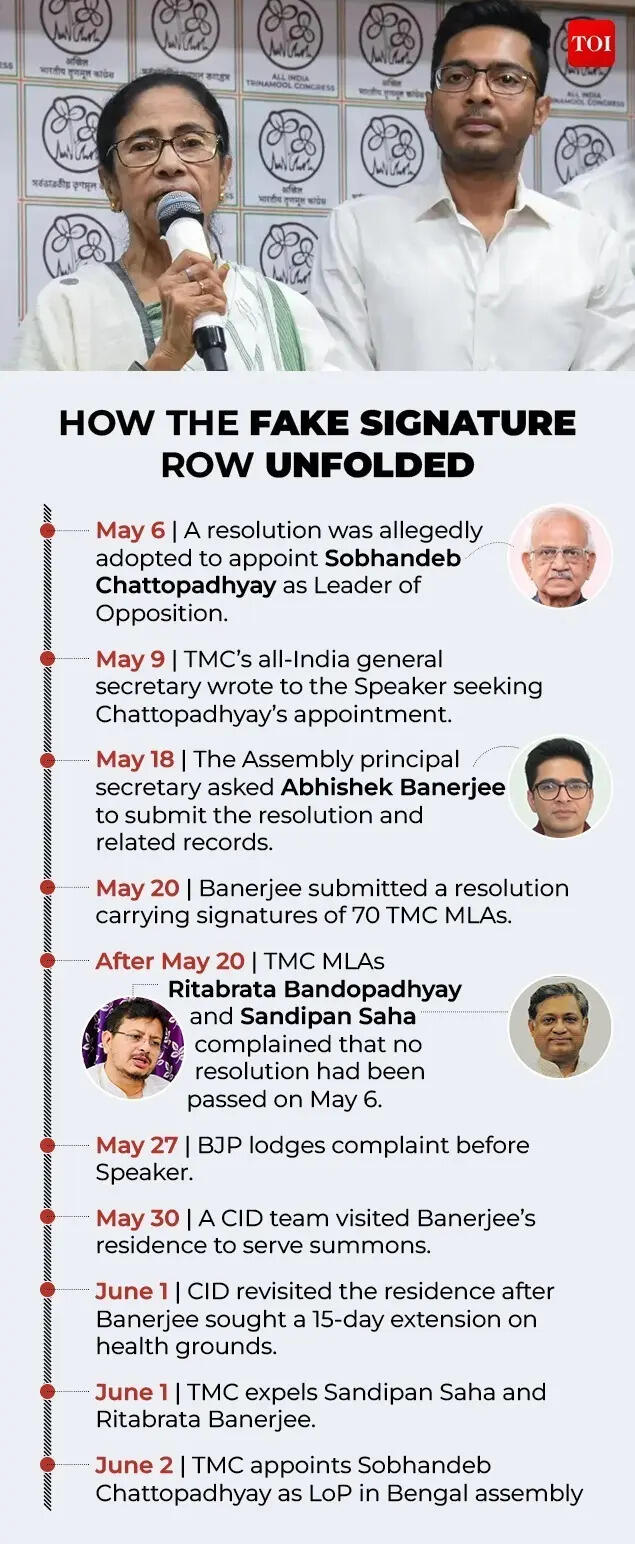
Row timeline
Senior TMC leader Kunal Ghosh also raised similar concerns at the time, though he later distanced himself from the rebel camp.The turning point A turning point came on May 22 when Ritabrata Banerjee, in Delhi to complete formalities related to the end of his Rajya Sabha tenure, visited Banga Bhavan and unexpectedly met chief minister Suvendu Adhikari. After the meeting, Ritabrata publicly praised Adhikari’s decision to invite opposition legislators and MPs to administrative review meetings, triggering intense political speculation.The crisis deepened on May 25 when allegations surfaced that the signatures of several MLAs had been forged on documents submitted to the Speaker regarding the leadership of the legislature party.Two days later, Ritabrata and Sandipan lodged a formal complaint with the Speaker. The Assembly secretariat subsequently approached the police, prompting a CID investigation.As legislators were questioned over the following days, the controversy rapidly evolved into a broader political confrontation. What began as a dispute over signatures became a rallying point for dissatisfied lawmakers and sparked intense lobbying behind the scenes.Bhaipo under mob attackTensions escalated further on May 30 after Abhishek Banerjee came under attack by a mob during a visit to Sonarpur. While party leaders publicly condemned the incident, several TMC figures privately viewed the muted response from sections of the organisation as evidence of growing estrangement between the leadership and some legislators.By the next day, the extent of the challenge confronting the leadership had become apparent. A meeting of newly elected MLAs convened by Mamata Banerjee at her Kalighat residence reportedly witnessed a lower-than-expected turnout, undermining efforts to project unity.The decisive rupture came on June 1. Shortly after Adhikari revealed that the CID probe had been initiated following complaints from Ritabrata and Sandipan, the TMC expelled both leaders.Rather than ending the crisis, the expulsions energised the dissident camp. Ritabrata and his supporters intensified their criticism of Abhishek Banerjee, accusing him of centralising authority within the party. Within rebel circles, the campaign came to be known as “Operation Crown Prince”.Legislative revolution?Efforts by the leadership to reassert control continued on June 2 through fresh communications to the Speaker regarding the legislature party leadership. However, support among legislators continued to drift towards the rebels.The showdown reached its climax on Wednesday when 58 MLAs submitted a letter electing Ritabrata Banerjee as leader of the legislature party and proposing a new leadership structure. The Speaker accepted the claim, effectively recognising the rebel faction as the official legislature wing of the TMC.Soon afterwards, many of the legislators involved attended a government review meeting convened by Adhikari at Nabanna, underlining the scale of the political realignment.The developments marked the biggest rupture in the 28-year history of a party built around the leadership and political appeal of Mamata Banerjee.There was also an ironic personal twist. Ritabrata, a former CPI(M) leader, had often cited Vladimir Lenin while describing Mamata Banerjee’s ability to connect with ordinary people, arguing that observing her political style helped him understand the Bolshevik leader’s theories of mass mobilisation.On Wednesday, he found himself leading what supporters called a “legislative revolution” against the very leader he had once compared to Lenin.For nearly three decades, TMC has revolved around a single leader. Fourteen days of rebellion have now exposed the risks, tensions and unanswered questions surrounding what comes after Mamata Banerjee.