








IIT is not just an institution, it is a dream nurtured by lakhs of aspirants in India. They move to places like the Kota factory to level their dreams and reach this prestigious university. However, with time the degrees are losing their value. Thanks to AI. In a world that is flooded with information, a question repeatedly makes students uncomfortable: Is an elite college degree still worth the effort?
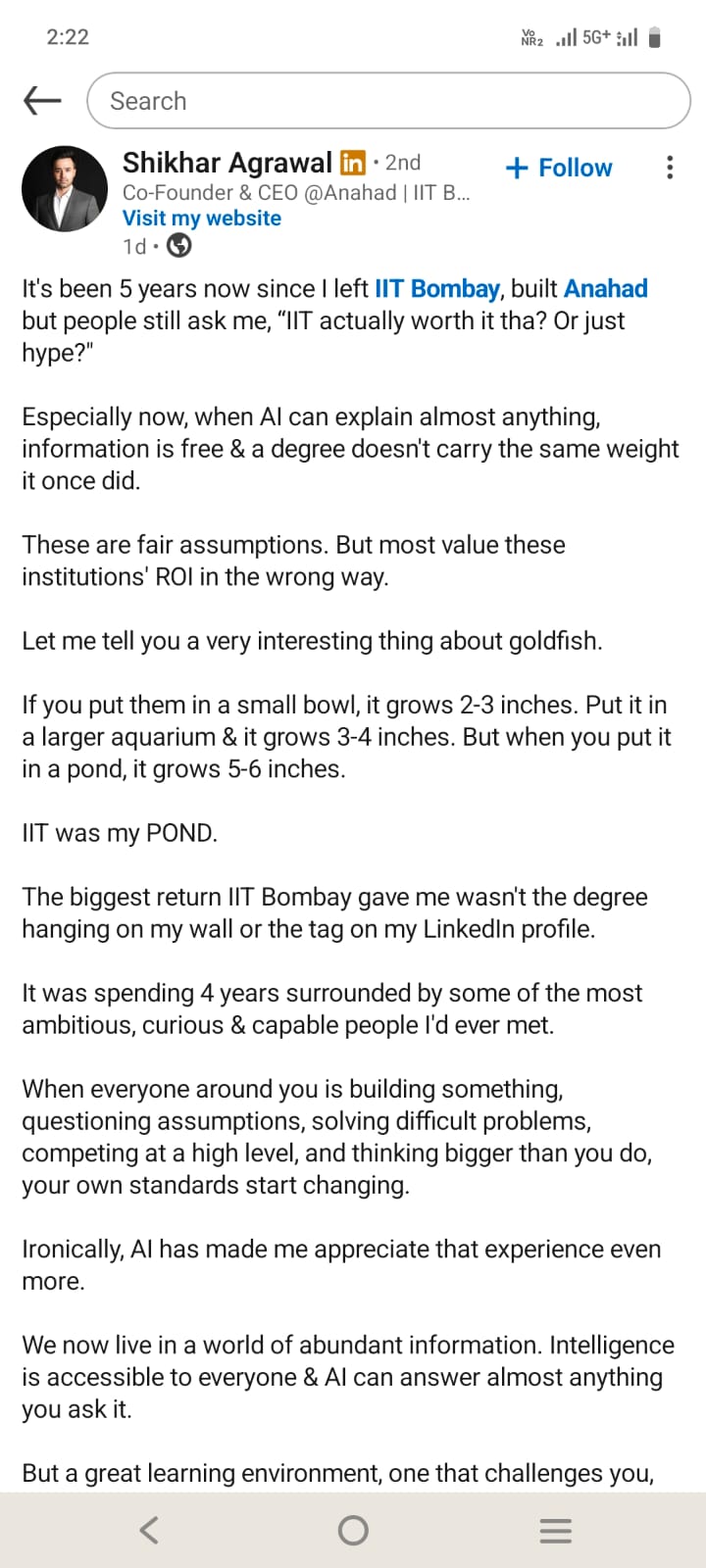
As artificial intelligence reshapes learning and challenges the traditional value of college degrees, Anahad CEO and IIT Bombay alumnus Shikhar Agrawal argues that the institution’s greatest return on investment was not its prestigious tag, but the transformative peer environment that continues to shape ambition, innovation and lifelong growth.
For many students preparing for highly competitive entrance examinations, the question goes beyond tuition fees or salary packages. It is about whether years of relentless preparation still make sense when AI appears capable of delivering information on demand.That is precisely the debate that prompted entrepreneur Shikhar Agrawal, co-founder and CEO of Anahad, to reflect on what his years at IIT Bombay truly meant.
A question that refuses to go away
Five years after leaving IIT Bombay and building his own venture, Agrawal says one question continues to follow him.“Was IIT actually worth it, or was it just hype?”The question, he noted in a recent LinkedIn post, has become even more relevant in the AI era. With conversational AI tools capable of explaining almost any concept, many believe the value of traditional degrees is beginning to fade.Agrawal, who graduated with a BTech in Mechanical Engineering from IIT Bombay in 2021, acknowledged that AI has fundamentally changed access to knowledge. Information, once locked inside classrooms, textbooks, and expensive courses, is now available to virtually anyone with an internet connection.Yet, he argues, that is precisely why people are misunderstanding the real return on investment of studying at an institution like IIT.
The biggest lesson was never taught in a classroom
Agrawal’s argument departs sharply from the conventional narrative surrounding elite institutions. It is not because of classroom lecture, academic syllabus, nor the prestige that comes along with studying at an IIT that he attributes most of his success.On the contrary, for him, the biggest gift from this educational institute lies in something intangible but long-lasting, and that would be its people.For him, spending four years around people who were so ambitious and gifted made him realize how much more he could aspire for in life.Being around peers who kept creating, questioning, solving tough problems, and dreaming big changed his perspective altogether. The influence, he suggests, came not through formal instruction but through everyday exposure to excellence.
The goldfish analogy
To explain his perspective, Agrawal turned to an analogy that resonated widely online. A goldfish, he wrote, grows according to the environment in which it lives. Place it in a small bowl, and it remains only a few inches long. Move it into a larger aquarium, and it grows bigger. Put it into a pond, and its growth expands even further.For Agrawal, IIT Bombay was that pond. The comparison was not about better buildings, laboratories or campus facilities. It was about the environment created by thousands of students who constantly inspired, challenged, and competed with one another.His message was simple: people often grow to match the expectations and ambitions of those around them.
AI has changed the value equation
Ironically, Agrawal believes artificial intelligence has strengthened, not weakened, his appreciation of that experience.AI has democratised information in ways unimaginable even a few years ago. Learning a programming language, understanding complex scientific concepts, or acquiring technical knowledge has become dramatically easier.Knowledge itself is no longer the scarce resource. What remains scarce, he argues, is an ecosystem that continuously stretches individuals beyond their comfort zones.While algorithms can answer questions within seconds, they cannot replicate the subtle but powerful influence of spending years among people whose ambitions constantly raise the bar.That daily exposure to curiosity, innovation and healthy competition, Agrawal believes, shapes thinking in ways no chatbot or search engine can.
The real return on investment
For decades, discussions about institutions like IITs have largely centred on placements, salary packages and global rankings.Agrawal’s reflection shifts the conversation elsewhere.Perhaps the true value of an elite institution lies less in the degree certificate and more in the invisible network of ideas, friendships, collaborations and intellectual challenges that students carry with them long after graduation.In an age where AI is rapidly narrowing the gap in access to knowledge, the competitive advantage may increasingly come from something technology still struggles to recreate—the human ecosystem that encourages people to think bigger than they otherwise would.For students weighing whether the pursuit of an elite college remains worthwhile, Agrawal’s answer is nuanced. The information available inside an IIT classroom may now be easier to access from anywhere. But the experience of growing alongside thousands of exceptionally driven peers, he argues, remains one of the institution’s most enduring, and perhaps irreplaceable, advantages.