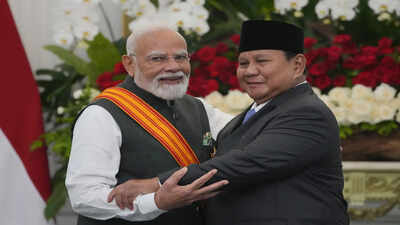







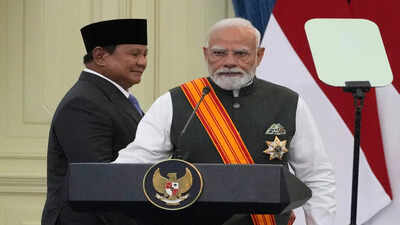
PM Narendra Modi underlined the need for urgent UNSC reforms, backed freedom of navigation in the Indo-Pacific and urged greater cooperation against terrorism, as he addressed the lawmakers in the Indonesian Parliament Complex seeking inclusive development, accessible technology and just and representative global governance. Modi announced a Ganga-Mahakam vision for India-Indonesia ties, focused on civilisational connect, shared development, defence and security cooperation, maritime prosperity and Global South priorities. The bilateral meeting earlier in the day saw both sides reaffirming their commitment towards a free, open, transparent, rules-based and inclusive Indo-Pacific, underscoring the importance of respect for sovereignty and territorial integrity and adherence to international law, along with freedom of navigation and overflight. However, the latest joint statement issued after Modi-Prabowo meeting dropped an explicit mention of the South China Sea issue that featured in the January, 2025, joint declaration after Prabowo’s visit to India. Despite the maritime friction with China in the North Natuna Sea, Jakarta has avoided a confrontational approach to the issue choosing to prioritise economic cooperation with its largest trading partner. While thanking Indonesian President Prabowo Subianto for standing solidly with India after the Pahalgam terrorist attack, Modi said the 2 countries can further expand cooperation in intelligence-sharing, cyber threats, terrorist-funding and de-radicalisation to strengthen the hands of peaceful forces. Indonesia backed India’s zero-tolerance approach to terrorism, and both sides expressed support for an MoU on counterterrorism cooperation that they are considering signing soon. However, like in the past, the carefully worded joint statement did not use India’s preferred terminology of cross-border terrorism or name Pakistan, or terror groups active on its soil, while seeking action against globally proscribed terrorists. India’s recent joint statement with Japan had named Pakistan for its support to cross-border terrorism. However, Indonesia maintains close ties with Pakistan and – while strongly backing India’s security concerns – has avoided any hostile rhetoric that might lead to a diplomatic spat with Islamabad. In his address, the PM said that global order is changing rapidly and in such a situation, developing countries are seeking equal participation and a bigger role. “In this global space, it is clear that the UN Security Council cannot ignore reforms,” said the PM, as he stressed that India and Indonesia’s strategic trust will be a strong foundation for stability in the Indo-Pacific. “As two great maritime nations, we will transform our shared maritime geography into shared prosperity. From Sabang to Great Nicobar, from Malacca Gateway to the Indo-Pacific, we will create new opportunities for connectivity, logistics, blue economy, maritime security and trade resilience,” said Modi, as he outlined his vision for maritime prosperity. MEA secretary (east) Rudrendra Tandon later said that while 2 meetings have already taken place on the Sabang port development in Aceh, close to the Nicobar Islands, another meeting is likely to take place soon. He emphasised that Indonesia’s independent and active approach and India’s commitment to strategic autonomy provided a strong foundation for the 2 countries to stand together on global issues. Modi reiterated India’s position that it follows the policy of development, and not expansionism. “And that is why we say in India, together with all, development for all. Our capital may be thousands of kilometers away, but in the sea, the distance between us is only 150 kilometers. In other countries, the sea may be the cause of borders and distances, but between India and Indonesia, the sea is no longer a symbol of distance. The sea is a center between us. It is the center of our shared future,” said the PM.