






The Royal Belgian Football Association (RBFA) has launched a formal challenge to FIFA’s controversial decision to allow United States striker Folarin Balogun to play in Monday’s FIFA World Cup Round of 16 clash, arguing that the world governing body has contradicted its own disciplinary regulations by suspending the enforcement of his automatic ban.The dispute has emerged just hours before Belgium face the United States in Seattle, where a place in the World Cup quarter-finals is at stake. Balogun had been expected to miss the match after receiving a straight red card during the USA’s 2-0 Round of 32 victory over Bosnia and Herzegovina at the San Francisco Bay Area Stadium on July 2. Instead, FIFA invoked Article 27 of its Disciplinary Code to postpone the suspension for one year, allowing the American forward to remain available for Mauricio Pochettino’s side.
FIFA invokes Article 27 to delay Balogun’s suspension
Balogun has been one of the standout performers for the co-hosts during the tournament, contributing three goals and three assists as the United States reached the knockout stages for the first time since 2002.His dismissal against Bosnia and Herzegovina, following a challenge on Tarik Muharemović, initially triggered the standard one-match suspension that accompanies a direct red card. FIFA, however, later announced that the sanction would not take immediate effect.
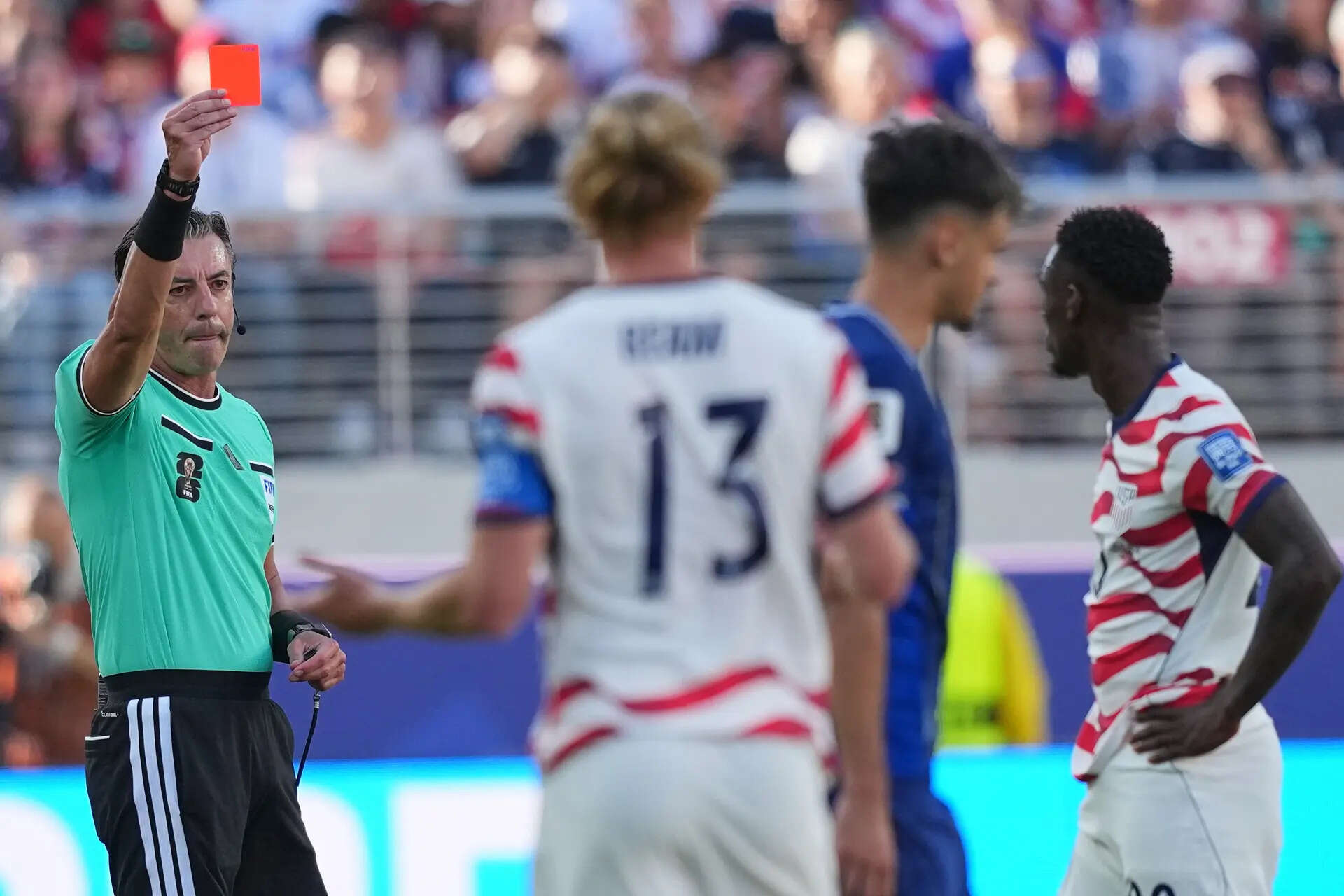
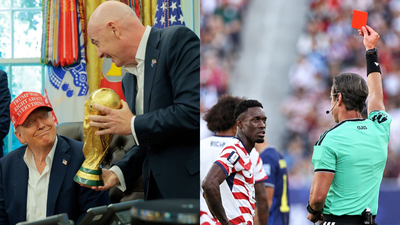
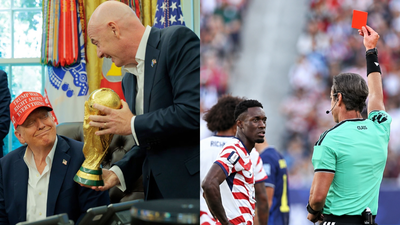
Referee Raphael Claus of Brazil shows a red card to United States’ Folarin Balogun, right, during the World Cup round of 32 soccer match between the United States and Bosnia in Santa Clara, Calif., near San Francisco, Wednesday, July 1, 2026. (AP Photo/Julio Cortez)
In an official statement, the governing body said: “In line with Article 27 of the FIFA Disciplinary Code, the implementation of the match suspension is suspended for a probationary period of one year.”FIFA further explained that if Balogun commits “another infringement of a similar nature and gravity during the probationary period, the suspension shall be revoked and the sanction enforced without prejudice to any additional sanction imposed for the new infringement.”Under the ruling, Balogun remains eligible to face Belgium immediately, while the suspension effectively remains on hold unless he commits a comparable offence during the next twelve months.
Belgium argue FIFA has contradicted its own regulations
The decision has prompted a strong response from the Royal Belgian Football Association, which released a lengthy statement expressing its surprise and questioning the legal basis for FIFA’s interpretation.“The Royal Belgian Football Association (RBFA) is astonished by FIFA’s decision to declare suspended United States player Folarin Balogun eligible to play in the USA–Belgium match on Monday, 6 July, at 5:00 p.m. (Seattle time),” the statement began.The RBFA acknowledged FIFA’s reliance on Article 27 but argued that other provisions within the same disciplinary framework clearly establish that a red card automatically results in suspension for the team’s next match.“FIFA bases its decision on Article 27 of the FIFA Disciplinary Code. This provision states that the FIFA Disciplinary Committee may decide to suspend the enforcement of a previously imposed disciplinary sanction.”The Belgian federation continued: “However, Article 66.4 of the same FIFA Disciplinary Code clearly provides that a red card (sending-off) automatically results in a suspension for the team’s next match, as has been the case for all previous red cards issued during this FIFA World Cup.”It also cited the tournament’s competition regulations.“Furthermore, and irrespective of the above, the decision is in direct contradiction with the provisions of the FIFA World Cup 2026 Competition Regulations, as set out in Article 10.5.”The federation quoted the regulation in full:“If a player or team official is sent off as a result of a direct or indirect red card (second caution), they will automatically be suspended from their team’s subsequent match. In addition, further sanctions may be imposed.”Belgium also pointed out that the same interpretation had been reinforced before the tournament.“The automatic nature of such a suspension was also explicitly reaffirmed in FIFA World Cup 2026 Circular No. 16, which was distributed to all participating member associations on 12 May 2026. The same rule is reiterated at every FIFA World Cup 2026 Match Coordination Meeting prior to each match and is included in all FIFA World Cup 2026 workshop presentations.”Concluding its statement, the RBFA warned it was considering further action.“In order to safeguard the legitimate rights of all participating teams and to protect the fundamental principles of fair play in our sport, both at this FIFA World Cup and at future editions of the tournament, the RBFA is investigating all potential options.”
Political reaction adds another layer to the controversy
The ruling has also generated political attention in the United States.President Donald Trump welcomed FIFA’s decision on Truth Social, writing: “Thank you to FIFA for doing what was right and reversing a great injustice! President DONALD J. TRUMP.”Before FIFA announced its ruling, US Secretary of State Marco Rubio had questioned Balogun’s dismissal while speaking to reporters at the White House.“They got screwed with that red card,” Rubio said. “There needs to be an appeal process for that. It’s probably too late for that, right?”British journalist Ben Jacobs later reported that the White House had contacted FIFA requesting that president Gianni Infantino review the incident. According to Jacobs, FIFA maintained that any outside influence was impossible because the decision rested solely with its independent disciplinary committee exercising powers available under Article 27. FIFA sources reiterated this position, stating that the disciplinary process is independent and that external political involvement, including any communication from the White House, could not influence the outcome of the ruling.
Quarter-final place on the line in Seattle
Unless FIFA unexpectedly reverses its position before kick-off, Balogun will be available when the United States meet Belgium on July 7 in Seattle.For the Americans, his availability provides a significant boost as they chase their first World Cup quarter-final appearance since 2002. For Belgium, however, the controversy has already become part of the build-up, with the country’s governing body insisting that it will continue examining every available avenue to challenge what it believes is an unprecedented interpretation of FIFA’s own disciplinary rules.