




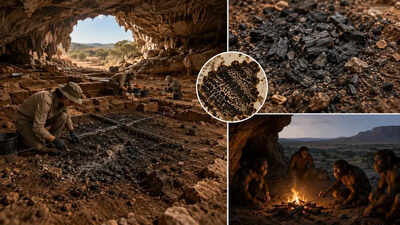
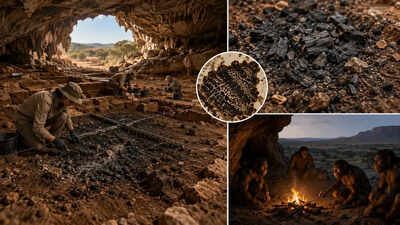
Inside the limestone chambers of South Africa’s Wonderwerk Cave, small fragments of bone have been telling a story that is only now becoming legible. The material itself is unremarkable at first glance, scattered, fragile, long stripped of any obvious context. Yet when placed under particular wavelengths of light, some of it behaves differently, as though carrying a memory of heat that is far older than the sediment around it. A new analysis places the heating deep in the past, between roughly 1.07 and 1.79 million years ago. It shifts an already significant site further back in time and raises a quieter, more complicated picture of how early human ancestors may have first lived alongside fire without fully mastering it.
Wonderwerk Cave fire evidence and the discovery of early human fire use
Wonderwerk Cave has already been part of the fire origin conversation for years. Earlier work pushed evidence of burning there to around a million years ago, which at the time stood among the oldest widely accepted traces linked to hominins, as reported under the study published in Plos One, titled, ‘New evidence for Early Pleistocene use of fire at Wonderwerk Cave (South Africa)’.The new layer of evidence sits even deeper in the deposit sequence. It comes from archaeological material associated with early Acheulean tools, typically linked with Homo erectus or close relatives. The setting is not near the entrance where sunlight and natural bushfires might have reached, but far inside the cave system, about thirty metres in. That detail matters because it reduces the likelihood that what is being observed is simply the residue of wildfires drifting in from outside. The method behind the revised dating is unusual compared with traditional archaeological approaches. Instead of relying only on visible discolouration or cracked surfaces, the team used a luminescence response in burnt bone.When exposed to specific light wavelengths, bone that has experienced high temperatures emits a faint but distinct glow. It is not something visible to the naked eye in normal conditions, and it does not require destructive sampling. In practice, it allows researchers to scan large quantities of tiny fragments without grinding them down or altering them.
Owl pellets and independent evidence of early fire activity in Wonderwerk Cave
The bones under examination were not part of butchered animal remains or clear signs of human meals. Many came from owl pellets, the compact regurgitated bundles of small prey that accumulate on cave floors over long periods. Owls would have used the cave naturally as a roosting space, leaving behind a steady record of rodents and small vertebrates.That detail complicates the picture in a useful way. These pellets form independently of human activity. So when burned fragments appear within them, it becomes harder to argue that the burning happened during later disturbance or deliberate deposition. It also suggests that fire was present in the cave environment itself, interacting with whatever was already there. Some layers show repeated burning rather than a single isolated event. That repetition is one of the quieter but more significant aspects of the finding.
Deep inside Wonderwerk Cave and the question of transported fire
Distance from the entrance is a recurring point in the analysis. The burnt material is located deep enough that natural fires sweeping across the landscape would struggle to reach it with any intensity. Combined with the absence of guano layers that might suggest spontaneous combustion, the environment starts to narrow down the possibilities.What remains is a scenario in which fire was brought into the cave rather than generated within it. There is no requirement here to assume controlled ignition in the modern sense. The interpretation leans instead towards opportunistic use of naturally occurring fire, likely originating from lightning strikes or wildfires outside.Early humans may have collected embers or smouldering material and carried it back inside. Once there, it could have been kept going for periods before dying out. The idea is not of mastery, but of intermittent use shaped by circumstance.
Fire use in the Acheulean period and evolving hominin behaviour
The Acheulean association places the activity within a long stretch of human evolution where behaviour is still being pieced together cautiously. Homo erectus is often discussed in relation to mobility, tool production, and gradual shifts in diet and environment. Fire, in this context, remains one of the most debated elements.What the Wonderwerk Cave material suggests is not control in the later sense of fire-making, but repeated interaction with it. Even that carries implications. Fire inside a sheltered space changes how animals behave, how food might be processed, how nights are spent. It also introduces risk, unpredictability, and effort in maintaining something that cannot be easily reproduced.