








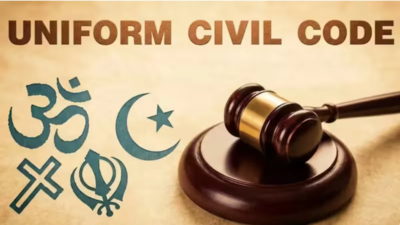
What changes for you and what doesn’t under UCC
The phrase Uniform Civil Code sounds deceptively simple. One country. One civil code. One set of rules for everyone, irrespective of religion.But India’s experiment with the UCC reveals a more complicated reality.A Hindu woman in Uttarakhand does not necessarily experience the UCC in the same way as a Muslim woman. A Christian family may see a different set of changes from a Muslim family. Some provisions alter the law substantially for one community while making relatively little difference to another.This is particularly clear in two areas: marriage and inheritance.The UCC’s prohibition of polygamy is a major change for Muslims because Muslim personal law traditionally permitted a Muslim man to have more than one wife. But Hindu, Sikh, Christian and Parsi laws already prohibited bigamy.Similarly, saying that the UCC “gives daughters equal inheritance” is incomplete. Hindu daughters already acquired equal coparcenary rights under the 2005 amendment to the Hindu Succession Act. Muslim daughters had a legal right to inherit too, but not an equal share as that of son.So the real story of the UCC is not simply what changes. It is what changes for whom and what happens when a change in law enters an Indian family?
What is UCC
India does not have one uniform set of personal laws governing marriage, divorce, succession and related family matters.Instead, different communities have historically been governed by different combinations of personal laws and legislation.Constitution Article 44: The State shall endeavour to secure for the citizens a uniform civil code throughout the territory of India.Explaining that Article 44 does not itself create or enforce a Uniform Civil Code, Delhi advocate Rupali Jain said, “It is a Directive Principle of State Policy, meaning it sets a constitutional objective: the State should endeavour to secure a UCC across India.” The idea behind the UCC is to move certain matters of family life away from religion-specific personal laws and place them under a common civil framework.Uttarakhand became the first state to bring such a comprehensive code into force on January 27, 2025. Gujarat, Assam and Madhya Pradesh have subsequently passed their own UCC legislation, while other BJP-ruled states are pursuing similar measures.That makes this no longer a theoretical constitutional debate as it becomes a question of how family life is legally organised.
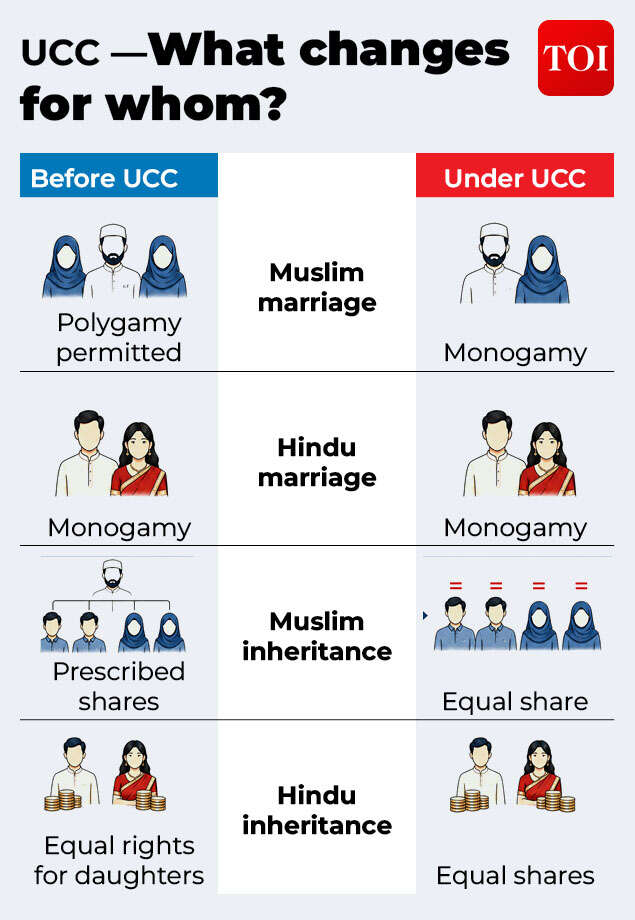
What actually changes under UCC?
MARRIAGE
Earlier, India had no single registration rule covering every marriage. Different personal laws and statutes followed different procedures. “A marriage could often be legally valid upon proper solemnisation even without registration but UCC mandates bring marriages covered by it under one common statutory registration framework,” said advocate Nikhil Kumar Jha.
What changes for Muslims?
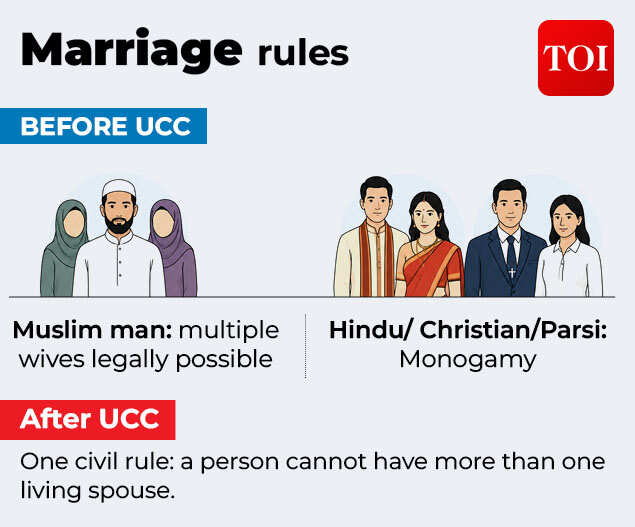
Under traditional Muslim personal law, a Muslim man could marry up to four wives, subject to the applicable conditions.UCC changes this. It requires a person seeking to marry to establish that they do not already have a living spouse. In other words, a Muslim man can no longer have more than one wife at the same time in a UCC-governed marriage.This is a substantive change for Muslims because polygamy was permitted under Muslim personal law.The practical consequence is significant: a Muslim man who already has a wife cannot enter another legally valid marriage under the UCC.
What changes for non-Muslims?
For Hindus, Christians, Sikhs and Parsis, the UCC’s monogamy provision does not represent the same kind of change.The Hindu Marriage Act, for instance, already requires that neither party have a living spouse when marrying. A Hindu marriage entered into while a spouse is living is void under the Act.Christian, Sikh and Parsi marriage laws also operate on a monogamous framework. So for these communities, the UCC largely carries an existing principle into a common civil framework rather than creating a new right or restriction.The same UCC provision appears to apply to everyone, but its impact is not the same for everyone.
What changes under the umbrella of marriage?
INHERITANCEInheritance is perhaps the area where the UCC is most easily misunderstood.The common claim that the UCC will give daughters equal inheritance rights makes it sound as though daughters previously had no right to their parents’ property. That is not true.
What changes for Hindus?
For Hindu women, the law had already changed substantially. The Hindu Succession (Amendment) Act, 2005 made daughters coparceners by birth, giving them rights equal to sons in ancestral property.The Supreme Court’s Vineeta Sharma judgment subsequently clarified the daughter’s right as a coparcener by birth. So a Hindu daughter did not enter the UCC era without an inheritance right. The UCC does not simply give Hindu daughters a new right to inherit. They already had substantial equal inheritance rights under Hindu law. The UCC replaces the religion-specific Hindu framework with a common set of rules governing who inherits when a person dies without a will. Under UCC, both father and mother of a deceased person are placed in the first category of heirs, whereas under the Hindu Succession Act the mother is a Class I heir but the father falls in Class II. “Coparcenary is only one part of succession law. A common succession scheme goes further by restructuring who qualifies as an heir, the order in which heirs inherit, how shares are distributed and what happens when a person dies without a will. The UCC’s broader change is therefore to replace community-specific succession systems with a common statutory framework governing intestate inheritance and identifying legal heirs,” said Jain.
What changes for Muslims?
The more dramatic difference appears when we compare this with Muslim succession law.Under Muslim succession rules, daughters are heirs. But the shares are prescribed according to the applicable rules of Muslim inheritance. In the familiar situation where a son and daughter inherit together, the son generally receives twice the share of the daughter.So before UCC, a Muslim son and daughter could both inherit but not equally. Under UCC, the religion of the deceased no longer determines the succession rule. The common framework provides equal treatment of male and female heirs in the relevant succession categories.That means the UCC’s inheritance change is far more substantive for a Muslim daughter than for a Hindu daughter, whose equal coparcenary rights already existed under the 2005 law.
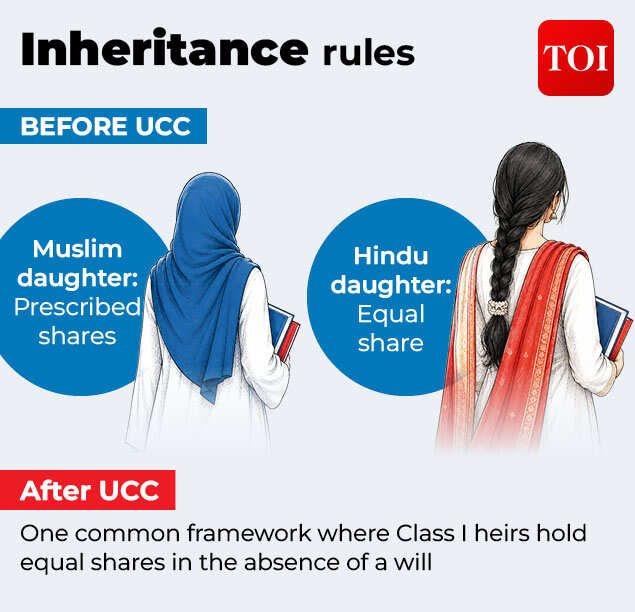
It is important to note that UCC does not mandate equal share of assets.
Does this mean a 50-50 split between son and daughter?
No. The story changes when there is a will in question that has specified shares mentioned.Dying without a will is not the same as leaving a will.The UCC does not say every daughter, son should receive 50% share. Nor does it mandate that parents distribute their property equally among their children through a will.If there is no will, the UCC’s common succession rules determine who inherits and in what shares. If there is a will, the property is distributed according to the testator’s wishes within the legal framework.So the UCC should not be sold to readers as a law that automatically makes every family’s property division equal.A parent can still make a will.A daughter can have a statutory right and still never receive the property if she voluntarily relinquishes it or the property is otherwise dealt with lawfully during the parent’s lifetime.Inheritance is more about mindset than legality.This is where the law meets Indian family sociology. The law can make a daughter equal. Can society? This is perhaps the strongest question to emerge from the inheritance debate.Because inheritance in India is not just a legal transaction. It can be an emotional negotiation. A daughter may hear: “Your brother will look after the parents,” or “you have your husband’s home,” or “We already spent money on your wedding.”She may sign away her share. She may never ask for it. Or she may insist on her legal entitlement and fight a battle with her family.This is why the real social impact of the UCC cannot be measured only by what percentage of property the law gives women.
LIVE-IN RELATIONSHIPS
This may eventually be one of the UCC’s most socially consequential provisions because it takes the law beyond traditional religious personal law and into a relationship that is, by definition, outside marriage.Marriage and inheritance involve areas where Indian law has long regulated family life. Live-in relationships are fairly new.UCC creates a formal registration framework for live-in relationships, including procedures for registration and termination. The state provides dedicated online services for both.This means the state is not merely deciding what happens when two people marry. It is also creating a legal framework around a relationship in which the couple has chosen not to marry.The justification can be protection — particularly in relation to partners and children. But it also raises a question about privacy: When two adults deliberately choose not to enter the legal institution of marriage, how much should the state know about their relationship?“The State’s justification is that registration creates an official record, helps establish the relationship during disputes and may protect partners and children by making rights easier to enforce. Registration does not automatically convert a live-in relationship into a marriage or give every marital right. Critics, however, question whether compulsory disclosure is proportionate. The larger debate is whether the State can protect vulnerable partners while respecting the privacy of adults who consciously choose to remain outside marriage,” said Jain.
Share your thoughts in the comments
Be respectful · TOI community guidelines
If the law is uniform, why are there different state UCCs?
The present state-level UCCs are attempts to create uniformity within a state, not across India. “Article 44 envisages a UCC throughout the country, but no single national Code currently exists. Therefore, states can adopt different frameworks, with different provisions and scope, until Parliament creates a common nationwide regime,” said Jha.Because the UCC is uniform in its application, but its effect is not uniform across people.
The real UCC question: Can law change society?
A law can say a Muslim man cannot have a second wife. But what happens to a woman whose husband enters another relationship informally?A law can give a daughter an equal inheritance entitlement. But what happens when her family asks her to give it up?A law can create common divorce rules. But what happens when a woman cannot afford to leave her marriage?A law can require a live-in relationship to be registered. But what happens to the idea of privacy between two consenting adults?These are not questions that can be answered by reading the title of a statute. They are questions about how law interacts with family, custom, money, gender and social pressure.The UCC does not change everything for everyone. It changes different things for different communities.