








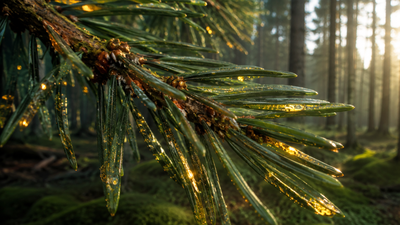
Deep inside the forests of northern Finland, scientists discovered something that sounded almost impossible at first: microscopic particles of real gold hidden inside ordinary tree needles. Researchers studying Norway spruce trees near the Kittila gold mining region found that the trees contained tiny solid gold nanoparticles absorbed from underground mineral-rich groundwater. The surprising discovery revealed a hidden partnership between tree roots, microbes and underground chemistry that slowly traps traces of gold inside plant tissues over many years. While the trees are not literally producing gold, the finding has opened new scientific discussions about how forests may help researchers locate hidden mineral deposits in a cleaner and less invasive way.
The strange forest phenomenon behind gold-filled leaves
The discovery took place in northern Finland near the Kittilä gold mine, one of Europe’s largest gold mining regions. Scientists collected samples from Norway spruce trees, scientifically known as Picea abies, growing above underground gold-bearing soil.Researchers were studying how plants interact with minerals underground when they detected tiny gold particles inside the tree needles. The finding immediately drew attention because gold is chemically stable and rarely appears as solid metal inside living plant tissues.The trees were not creating gold themselves. Instead, the gold already existed underground in dissolved form inside groundwater.Trees continuously absorb water and nutrients through their roots. Along with essential minerals, very small traces of dissolved metals can also move into the plant’s tissues. Scientists believe microbes living around or inside the plant played a crucial role in the process.These microorganisms formed protective biofilms around dissolved gold ions. Inside these microscopic environments, chemical conditions changed in ways that caused dissolved gold to transform into tiny solid particles. Over time, these microscopic gold nanoparticles became trapped inside the tree needles.The discovery highlighted how important microbes can be in shaping underground chemistry.Microbes can alter oxygen levels, acidity and chemical reactions in surrounding water. These changes may force dissolved gold out of groundwater and convert it into solid metallic particles.The process happens extremely slowly and remains invisible to the naked eye. Scientists used specialised microscopes and chemical analysis techniques to confirm the presence of gold nanoparticles inside the plant tissues.
The significance of the discovery
The study revealed that forests may function as natural indicators of underground mineral deposits.Scientists already use a method called biogeochemical prospecting, where plants are analysed to detect traces of underground minerals. Certain plants can absorb metals such as nickel, zinc, copper and even tiny traces of gold.The Finland discovery strengthened evidence that trees and microbes together may help scientists identify hidden mineral-rich regions without extensive drilling.Researchers say this approach could reduce environmental damage caused by exploration, lower mining survey costs, help locate buried mineral deposits in remote areas and limit invasive excavation methods.
Gold in plants is not entirely new
Scientists have previously found traces of gold inside plants in other regions of the world.In Australia, earlier studies detected tiny gold particles inside eucalyptus leaves growing above underground gold deposits. The roots of some trees can extend deep underground and absorb groundwater carrying dissolved minerals.However, the Finland discovery attracted particular interest because of the apparent role microbes played in transforming dissolved gold into solid nanoparticles inside living tissues.
Why gold is unusual inside living organisms
Gold has no known biological purpose for plants or animals. Unlike elements such as iron, potassium or magnesium, living organisms do not require gold to survive.That is why scientists were surprised to find actual solid gold particles inside the spruce needles. Although the particles were microscopic and harmless at such low concentrations, their existence revealed surprisingly complex interactions between geology, microbiology and plant biology.
Could forests help future mining exploration?
The discovery is unlikely to replace traditional mining, but it could change how scientists search for underground resources.Modern mineral exploration often involves drilling, excavation and large-scale environmental disruption. If researchers can reliably use trees as natural geological sensors, mineral surveys may become faster, cheaper and more environmentally friendly.Scientists believe combining plant analysis with geological mapping and chemical surveys could improve future exploration techniques.The idea of “gold growing on leaves” immediately captured public imagination because it sounds almost mythical. But beneath the dramatic headline lies a real scientific story about how living organisms interact with Earth’s geology in ways researchers are still trying to understand.The discovery serves as a reminder that forests are not just passive landscapes. Beneath the soil, trees, microbes, water and minerals are constantly interacting through hidden chemical systems that can quietly reshape the environment over time.