








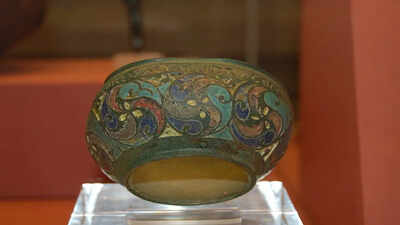
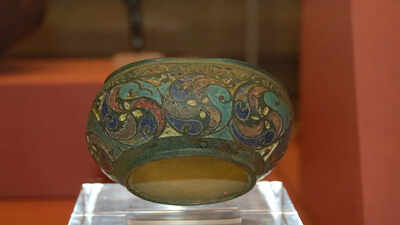
The Romans also had their own way of commemorating their travels, even before the invention of digital photography and refrigerator magnets. In 2003, an amateur archaeologist using a metal detector uncovered an ornamented metal artefact buried under the soil while surveying a field in the Staffordshire Moorlands. From a distance, the object could be mistaken for some kitchen utensil or scrap metal from a broken bronze cauldron. But once the dirt was scraped off, it turned out that the item was actually inscribed with elaborate enamel designs and cryptic words.Thus, the unique artefact found is called the Staffordshire Moorlands Pan. The discovery made historians reconsider their understanding of the way people living on the outskirts of civilisation lived. Not only was the object used for practical purposes, such as drinking and cooking, but it was also created to commemorate a trip to some location. One may say that it is like a sophisticated souvenir which people buy nowadays when travelling to various places to have something that can remind them of what they saw.Miniature map of Hadrian’s Wall inside an enamelWhat makes the discovery truly amazing is the inscription, which is located around the upper rim of the vessel. According to the research work called Living on the Edge: The Staffordshire Moorlands Pan and Life Along Hadrian’s Wall, the names of four forts located at the western end of the wall are listed there. The forts mentioned are called Banna, Camboglanna, Uxelodunum, and Maia. These names form a geographic itinerary of the area.The design of the piece features elegant whorls in the so-called “Celtic” style in colours such as blue, red, and yellow. As noted on the website of the British Museum Collection, such a decorative element became highly fashionable in second-century northern Britain. Thus, the fusion of Roman names in Latin and artistic techniques common to the local culture demonstrates a truly interesting cultural combination, which, presumably, indicates that the item was created for someone who viewed their stay at the frontier as an important event worthy of celebration through luxury items.
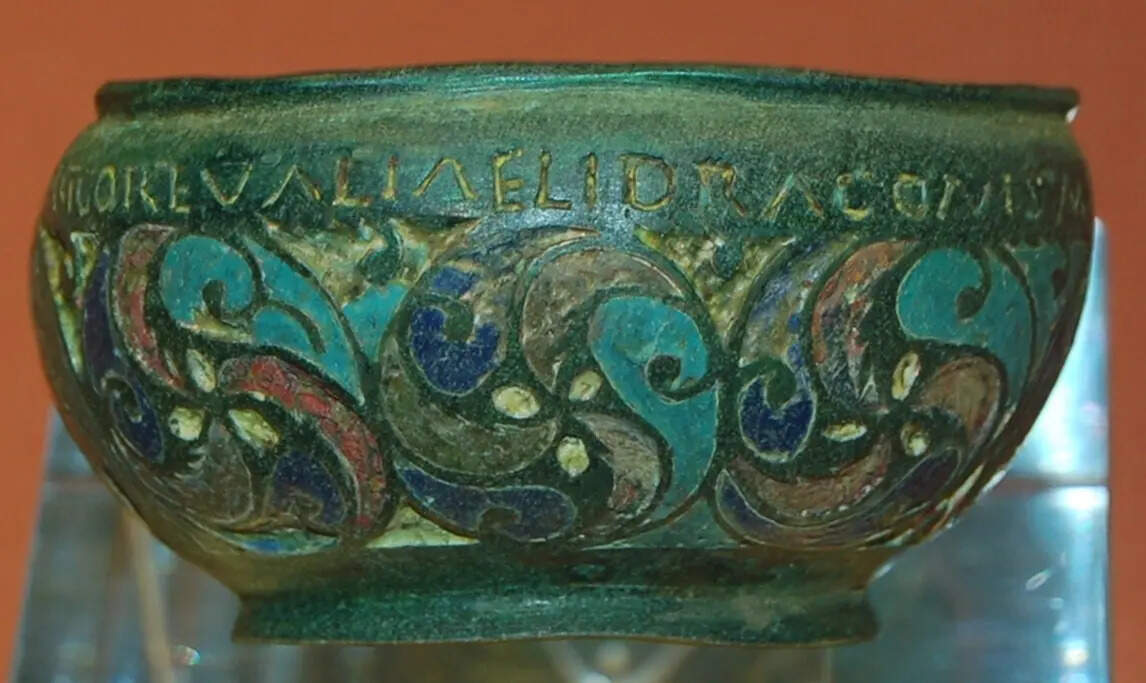
Inscribed with fort names along Hadrian’s Wall and featuring local artistic styles, this sophisticated souvenir commemorates a journey. Image Credits: Portable Antiquities Scheme from London, England, via Wikimedia Commons
A little pan that adds a human dimension to a huge empireWhen thinking of the Roman Empire, we tend to imagine a number of imposing stone structures, military tactics, and war campaigns. In contrast to this picture, the Staffordshire Moorlands Pan gives us insight into a completely different side of history, one that can hardly be captured by huge fortifications. The discovery of such a pan proves the uniqueness of the object since, according to the Portable Antiquities Scheme discoveries report, there are only three or four vessels of this kind ever discovered.The discovery of the pan in Staffordshire, which is quite a distance from the wall, shows that the artefact did move around. This means that it travelled with somebody who was travelling south, away from the frontier, probably on their way back home or being transferred to another location. This helps illustrate the point that for each soldier assigned to guard duty in a solitary tower, there was someone else with memories, a life and a history outside of the fortress walls.Today, the Staffordshire Moorlands Pan is shared between several major museums, where it continues to fascinate visitors with its bright colours and tiny, perfect lettering. It serves as a reminder that the objects we choose to keep say a lot about who we are. Just as we might keep a postcard or a shell from a beach, a Roman traveller once looked at this pan and remembered the wind-swept hills of the northern frontier.The amazing thing about it is that although the Roman Empire eventually declined and the magnificent fortresses were reduced to rubble, this little cup remained intact amid the muck. It outlived the very structures it was supposed to memorialise.