




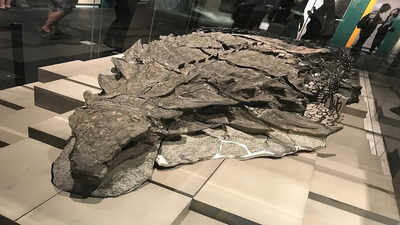
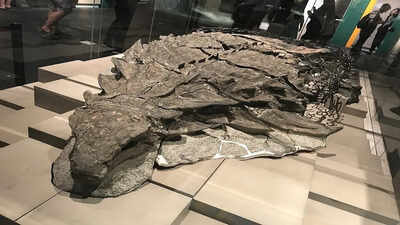
In 2011, a heavy equipment operator at an oil sands mine in northern Alberta was having a pretty normal work day when he spotted something unusual in the rock. What he had stumbled upon became one of the greatest dinosaur discoveries in recorded history. It was not just a set of fossilised bones, but an animal that looked almost exactly as it did 110 million years ago.Miner’s eye for the unusualThis was the Suncor Millennium Mine, an enormous industrial complex in the oil sands of northern Alberta. When the strange lumps were examined, scientists quickly realised they were looking at an armoured dinosaur unlike anything previously recovered. The specimen was later formally named Borealopelta markmitchelli. Its holotype designation is TMP 2011.033.0001 as confirmed by a study published in the journal Peer J which places the find firmly within the scientific record.What was really remarkable about the find wasn’t so much the animal as the totality of it. This wasn’t a matter of a few stray bones or even a partial skull. It was a large articulated body, preserved with the skin, scales and armour still attached. It was like the scientists had a window into what this creature looked like in the flesh.Why is this fossil so uniqueThe Royal Tyrrell Museum, where the Borealopelta is now displayed, calls it the best-preserved armoured dinosaur ever found, and the science supports that. Most dinosaur fossils lose their soft tissue long before they even enter the fossil record. Here, the outer coverings of the armour, the horny epidermal sheaths over the osteoderms, were still in place. That sort of detail is almost unheard of.Here’s a way to think about it: Most of what we know about ancient animals is based on bones alone. Borealopelta gave scientists the whole picture: the actual texture and shape of an animal that walked the Early Cretaceous. For palaeontologists, it is like finding a perfectly preserved photograph in a world where you have only ever worked with rough sketches
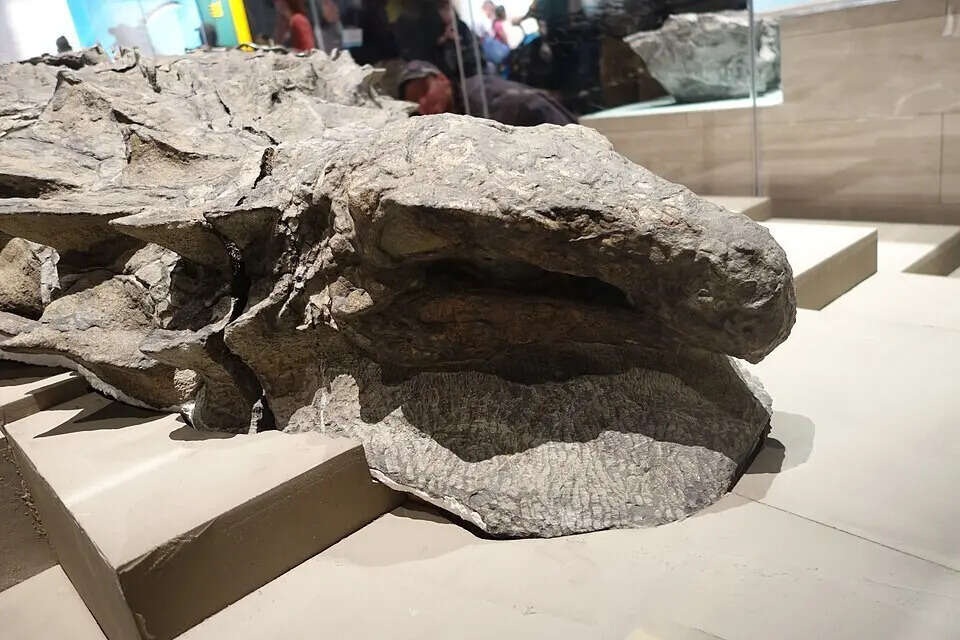
The Borealopelta markmitchelli fossil on display at the Royal Tyrrell Museum in Alberta, preserving skin, scales, and armour exactly as they appeared in life. Image Credits: Wikimedia Commons
How the rock preserved it for 110 million yearsThe geological story behind the preservation is as interesting as the fossil itself. In 2020, a study in Royal Society Open Science found Borealopelta in a marine sandstone unit within the Clearwater Formation, a layer that also contained articulated marine reptiles. It was a land-dwelling dinosaur that had found its way into a marine burial environment. It was that geographical accident which saved it.Rapid burial in marine sediments, likely under specific chemical conditions, formed a natural seal around the body. The dinosaur was locked in the rock, nearly intact, rather than rotting or being scattered. For more than 100 million years, it lay undisturbed in those sediments, waiting for an Alberta mine to cut into the surface and uncover it.It even kept what the dinosaur last ateIf all that wasn’t amazing enough, the same 2020 study revealed something incredible. The fossilised stomach contents of Borealopelta could still be identified. The researchers discovered plant remains in the body, offering science a direct insight into what this animal ate just before its death. The last meal of a big armoured dinosaur preserved in the rock along with its body is just the sort of detail that sounds too good to be true.That combination of anatomy, armour and diet has made Borealopelta so much more than a museum centrepiece. It’s a scientifically rich specimen that researchers can investigate across multiple fields, from how armoured dinosaurs were built to what they ate to how their ecosystems worked.The lucky breakThe story of Borealopelta is a reminder that some of the most important scientific records of Earth are still waiting in rock to be exposed. Deep in the oil sands mines of northern Alberta, ancient geological layers are dug up, and in this instance, the industrial activity uncovered a 110-million-year-old animal. It all started when a worker noticed something odd at work and uncovered one of the most important dinosaur fossils ever found in North America.