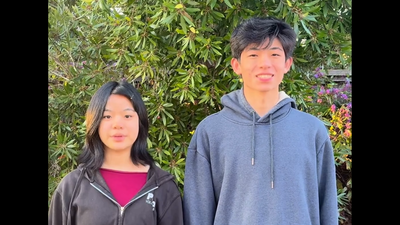









A used paper towel is rarely given a second thought. Once it has wiped up a spill or dried a surface, it usually goes straight into the bin, while the material it was made from has already passed through a much longer chain of production. International Science and Engineering Fair reported that Arnav Kodavati, a 17-year-old student from California, has been looking at that cycle from the other end. His science project explores whether discarded food can provide the cellulose needed to make a biodegradable paper towel, turning part of the waste stream into a new everyday material.The process involves recovering cellulose-rich fibres from food scraps, combining them with pectin and strengthening the resulting sheets with calcium ions. Tests showed that the material could absorb several millilitres of liquid while retaining useful wet strength. The project also examined whether such sheets could eventually be produced at a cost competitive with some existing sustainable paper products.
How discarded food scraps are being turned into useful cellulose fibres
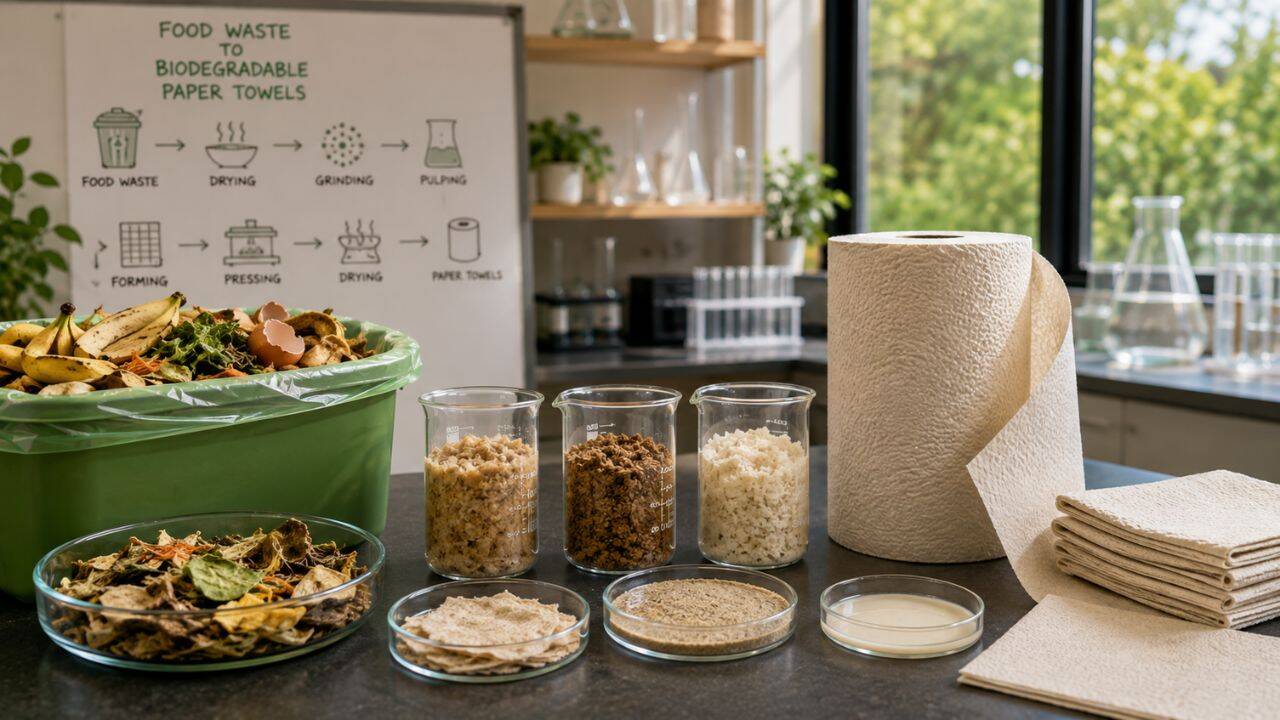
Food waste contains far more useful material than its final destination might suggest. Large quantities of discarded food contain cellulose and other plant-based polymers, but much of that material is treated simply as rubbish.Kodavati’s project takes advantage of the cellulose present in this mixed biomass. The basic idea is fairly straightforward, although turning it into a usable sheet is not. Food scraps first have to be dried and reduced into smaller particles before unwanted components can be removed. The resulting material then goes through a series of chemical treatments designed to leave behind cellulose-rich fibres suitable for making a paper-like structure.In a video shared as part of the project, Kodavati walks through the idea behind the food-waste-derived sheets and the work involved in developing them. HIs small footage reveals a closer look at the project and helps show how discarded food is processed before being turned into the biodegradable paper-towel material.
Science behind stronger, water-resistant food-waste sheets
A sheet intended to work as a paper towel needs to do two things that can be difficult to achieve at the same time: it has to take up water quickly, but it cannot simply fall apart once it becomes wet. Kodavati combined the recovered fibres with pectin, a naturally occurring polymer widely associated with fruits and other plant material. The mixture was formed into thin sheets before being treated with calcium chloride.The calcium ions play a structural role. They connect with charged groups on the pectin molecules, creating small junctions throughout the material. In practical terms, this gives the sheet a more stable internal network when water enters it. Without some form of reinforcement, a cellulose-based absorbent sheet can lose much of its integrity as it becomes saturated. The calcium-linked pectin network was intended to address that weakness without relying on conventional synthetic binders.
AI Generated
How the sheets were tested for strength and absorption
A highly porous sheet can draw in liquid rapidly, but increasing the amount of material used to strengthen it can alter the way water moves through the sheet. Kodavati’s work examined that relationship rather than treating absorbency and strength as separate targets. The project used mathematical models to describe how liquid travelled through the pores and how quickly the sheets approached their absorption limit.The testing pointed towards formulations with relatively small effective pore sizes, roughly 20 to 30 micrometres, while the amount of binder and the weight of the sheet could be adjusted to change the balance between the two properties.According to ISEF, adding the calcium-based crosslinks reduced the speed at which the sheets absorbed liquid by around 20 to 40 per cent in some formulations. That came with a substantial gain in wet strength. Measurements increased from about 0.19 newtons in the uncrosslinked material to as much as 0.34 newtons after crosslinking.
How much liquid could the sheets hold
The prototypes were tested using small 5-by-5-centimetre pieces. The stronger formulations were able to absorb roughly 5 to 6 millilitres of liquid per sheet while retaining measurable wet strength.The work also explored different sheet weights and binder concentrations rather than settling on a single recipe. The most promising combinations fell within a range of roughly 30 to 60 grams per square metre, with pectin making up around 15 to 25% of the formulation.
How the process could fit into existing paper production
The treatment sequence used in the project involved acid, alkaline and bleaching stages to clean and separate the cellulose-rich fibres. The sheets were then cast and treated with calcium chloride.Those steps are significant because they are based on operations already familiar to the paper and fibre-processing industries. The project is therefore not proposing an entirely unfamiliar manufacturing route. Its central change is the source of the cellulose.There is still a difference between demonstrating a material in a controlled setting and producing millions of sheets consistently. Food waste is variable, for example, and the composition of discarded material can change considerably depending on what goes into the feedstock. Any larger-scale process would have to cope with that variation while keeping the fibre quality and chemical requirements under control.
How the prototype compares on price
Sustainability claims often become more complicated when the price of the finished material is considered. A biodegradable alternative may have environmental advantages, but consumers and manufacturers still have to be able to afford it.Reportedly, the project estimates that its prototype material could cost about $2.98 for 100 sheets at scale. That compares with an estimated $3.40 per 100 sheets for the sustainable paper towel product used as a benchmark in the project.The figures are projections rather than evidence of a commercial product already being manufactured at that price. Large-scale production would introduce costs associated with collecting and preparing food waste, transporting the raw material, processing chemicals, equipment, energy and quality control.
From paper towels to wipes and packaging: Where the material could go next
The chemistry behind the sheets is relatively modest, but it is central to the performance of the material.Pectin provides the polymer network, while calcium ions act as links between parts of that network. When the finished sheet becomes wet, those connections help prevent the structure from losing its shape too quickly.That approach also avoids relying on a conventional plastic-based strengthening agent. For an absorbent product that is ultimately discarded, the choice of binder matters almost as much as the fibre itself. A sheet made from renewable waste would offer a limited environmental benefit if its performance depended heavily on materials that were difficult to break down. The project is not restricted to kitchen rolls. The same combination of recovered cellulose, a plant-derived binder and calcium-based reinforcement could potentially be adapted for other disposable absorbent products.Possible uses include wipes, packaging materials and absorbent mats. Each would bring its own requirements, though. Packaging may need greater stiffness, while a wipe would need a different balance of softness, strength and liquid uptake.