





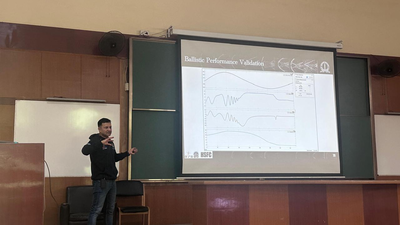
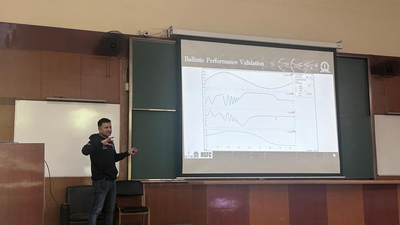
BENGALURU: Inside a seminar room at the Indian Institute of Science (IISc) on Monday, astronaut Group Captain Angad Pratap laid out a scenario spacecraft designers prefer never to confront: a crew module hurtling back to Earth with its primary Navigation, Guidance and Control (NGC) system compromised.His answer is not to replace automation, but to add a tightly designed human fallback. Angad was presenting his MTech thesis.“Now that he has presented his thesis before a colloquium, the next step is to send it out for an external review, and we will have to incorporate those comments when he presents his final thesis and defends it. His thesis should go out in a couple of weeks or so and we expect the reviews to come in a month after that. So I think Angad will probably do his thesis defence in about six weeks or so and complete the MTech programme,” Prof Jishnu Keshavan, Angad’s MTech guide, told TOI.Angad’s research tests whether astronauts can manually guide a spacecraft through atmospheric re-entry using a simplified control scheme. The idea centres on bank-angle control — the same principle used by automated systems — adapted for human input under constrained conditions.Re-entry is unforgiving. A steep descent can drive temperatures beyond tolerance; a shallow one risks the capsule skipping off the atmosphere. Automated systems are designed to track a precise trajectory, correcting for disturbances in real time. Angad’s study asks what happens if that chain falters.TOI had reported last year that Angad was working on a manual guidance framework. The latest presentation shows that the work has moved from concept to simulation-backed validation. Angad is an “Academics Torch Winner” at the National Defence Academy (NDA) in 2001 & 2002, and received a “Merit Card for Academic Excellence” at the Airforce Academy (AFA) in 2004.Instead of continuous piloting, the proposed system uses a “supervisory control” approach. Astronauts make discrete roll inputs at intervals, nudging the vehicle back towards its reference path while a degraded NGC system continues to provide partial support. This reduces workload at a time when cognitive and physical stress are high.The model has already been institutionalised as a research Test Bed and is flying at Isro’s Human Space Flight Centre (HSFC) with Gaganyaan CAD model. And, it is expected to be implemented in Gaganyaan’s G-2 mission.Using six-degree-of-freedom simulations that model both motion and attitude, the team has demonstrated that a pilot can maintain a stable descent profile from about 120 km altitude down to parachute deployment. The results indicate that key parameters — including thermal loads, deceleration and trajectory deviation — remain within acceptable limits. Simulations also show that mid-course overshoots can be corrected through controlled bank-angle adjustments.One of the more practical outcomes is that the system does not demand new hardware. The control logic and display design can be integrated into existing spacecraft architecture, relying on a reduced set of flight cues to guide the crew.The work draws from earlier human spaceflight experience, including missions by Nasa, where astronauts retained limited manual authority during critical phases. But in modern spacecraft, automation has largely taken over, with manual redundancy often seen as unnecessary or too complex.Angad and Keshavan’s study argues otherwise. By narrowing the scope of human intervention to a few critical inputs, it suggests that manual control can serve as a viable last layer of safety.